Winter Driving Tips Edmonton Drivers Need Before the First Snow
Learn the braking, black ice, following distance and visibility habits Alberta recommends, applied to Edmonton streets, plus what our winter classes add.
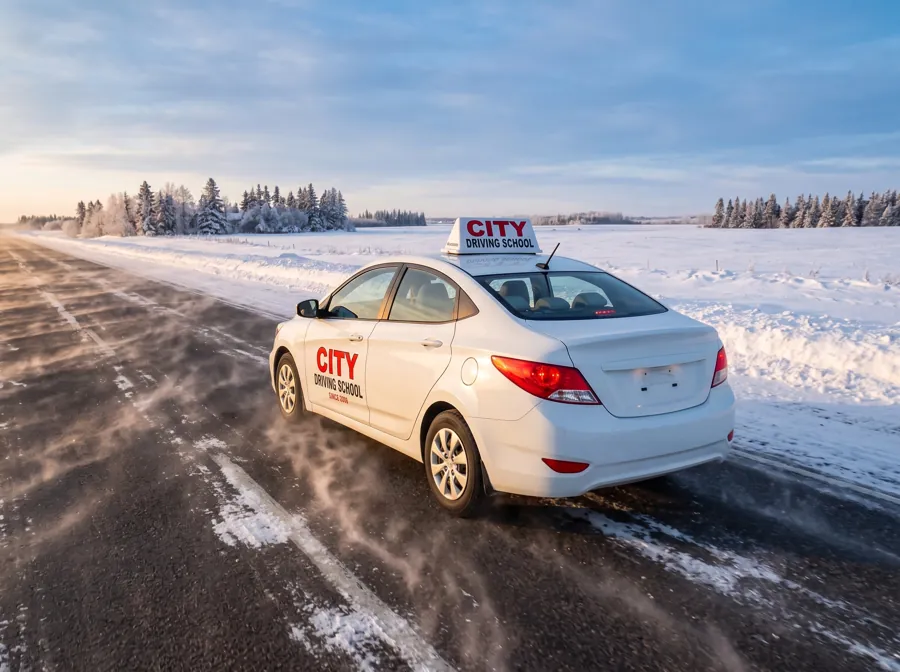
The winter driving tips Edmonton drivers need most come down to a few habits. Brake gently, leave far more room, clear the whole car and know where ice hides. This post takes the winter driving advice the Government of Alberta publishes and applies it to Edmonton streets, snow clearing and parking bans.
Brake and steer gently on ice
Posted limits are set for ideal roads, and winter roads are not ideal. Alberta says you must drive to the conditions and can be ticketed if you do not.
- Be gentle with the brake pedal on slick roads.
- Avoid braking on curves. Drive through at a safe, steady speed.
- Never use cruise control in winter conditions.
- Gear down for uphill and downhill grades to avoid brake wear and sliding.
The Driver's Guide adds that with ABS you can brake as hard as you need and still steer.
If the car starts to skid
Take your foot off the brake and steer where you want to go. When the wheels grip again, brake firmly and smoothly.
Black ice: where it hides on Edmonton streets
The Alberta Driver's Guide says black ice is moisture freezing on the road surface, and a driver often cannot see it. Watch for asphalt that looks shiny and black instead of grey-white. When you see that, reduce your speed without braking.
Shaded stretches can stay icy after the sun has cleared the rest of the road. Bridge decks and overpasses get slippery sooner than the road around them, so avoid needless lane or speed changes there. In Edmonton, crews sand and salt ramps, bridge decks and river valley hills while snow still falls. Slow down before those spots.
Following distance: three times normal
Most winter driving tips Edmonton drivers hear start with the gap in front. Under normal conditions the Driver's Guide asks for at least two seconds behind the vehicle ahead. When the car in front passes a fixed object, count one-thousand-and-one, one-thousand-and-two. If you reach the object first, you are too close.
In winter that is not enough. Alberta's winter driving tips say to allow at least three times the normal following distance on slick roads.
Flashing amber and red lights mean a snowplow is ahead, so stay back until it lets you pass.
Clear the whole car and keep your headlights on
Before you pull away, clear snow and ice from the windows, side mirrors, headlights, taillights and licence plates. Keep your headlights on so drivers behind you can see your taillights. Daytime running lights do not light the rear of the car. The Driver's Guide adds that you must turn your headlights on whenever you cannot clearly see 150 metres ahead.
Signal early, check your mirrors and shoulder check before every lane change.
Edmonton snow clearing phases and parking bans
Provincial winter driving tips Edmonton drivers read do not cover the City's own snow plan, yet that plan decides which streets stay icy longest. While snow is falling, crews focus on major roads such as Whitemud Drive and Yellowhead Trail. Once it stops, four priorities apply.
The four clearing priorities
- Priority 1. Main freeways, major arterial roads and downtown business districts: bare pavement within one day.
- Priority 2. Remaining freeways, secondary arterial roads, collector roads and transit routes: bare pavement within five days.
- Priority 3. Industrial hubs and rural roads: bare pavement within six days.
- Priority 4. Residential roads and alleys: bladed to a snowpack of about 5 cm, within 14 days once a cycle starts.
So a residential street stays snow-packed on purpose. The City says warm days can turn it slushy and slippery, with ruts after a refreeze.
Phase 1 and Phase 2 parking bans
Not every snowfall brings a ban. The City calls one when heavy snow falls over a short time, with at least eight hours notice before enforcement.
- Major Roadways (Phase 1). Arterial and collector roads, bus routes and business areas, city-wide, 24 hours a day, for about three to four days. Watch for white seasonal no parking signs.
- Residential (Phase 2). Residential and industrial areas. The ban can run up to 14 days, but each neighbourhood is affected for about 72 hours. Yellow no parking signs go up at neighbourhood entrances at least 24 hours before clearing.
A vehicle left on a banned street can draw a fine of 250 dollars. Sign up for the City's Service Notifications by address, check the Roadways Snow Clearing Map, or ask 311.
Pack a winter survival kit
Alberta says to stay off the road in winter storms unless travel is necessary, and to carry an emergency kit with:
- first aid kit, fire extinguisher and blanket
- extra clothing and footwear
- flashlight with extra batteries, a candle in a deep tin and waterproof matches
- shovel, booster cables, ice scraper and snowbrush
- sand, road salt or non-clumping kitty litter
- food that will not spoil, such as granola bars, nuts or chocolate
- paper towel or rags, a road map and compass, and a cell phone
What City Driving School offers
The winter driving tips Edmonton learners need are simple to read. The hard part is doing them at the first snowfall. Our winter driving classes run in a classroom, not in the car, with men and women instructors certified by Alberta Transportation.
The winter driving course comes in packages of two, four or eight hours, at $120, $240 or $450 plus GST in every zone. If you want an advanced winter driving course, the eight hour package gives the most class time.
For time on real winter roads, book a Brush-Up. It is two hours in our car from $120 plus GST, with free pickup and drop-off inside our service areas. Book in five steps on our booking page and pay by PayPal or at the office.
Book before the first snowfall
Call us any day between 7:30 am and 8:00 pm at (780) 965-1151 or (780) 469-1152, and we will find you a class time or a Brush-Up slot. You can also Book a lesson online.