Highway Lessons in Edmonton and How to Know You Are Ready
Learn when you are ready for highway speed, what a lesson covers, and which City Driving School course adds the in-car hours.
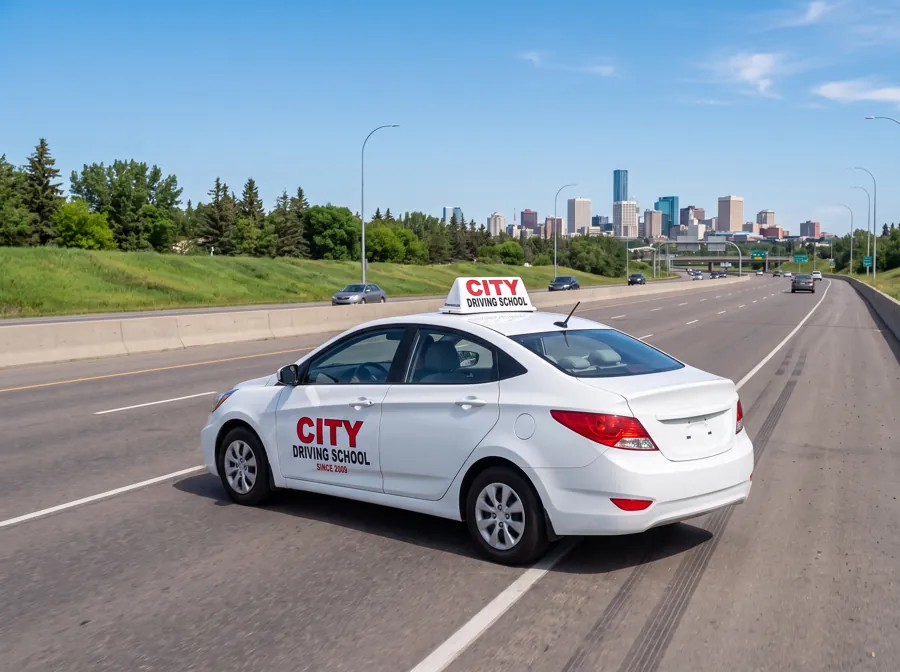
Highway lessons are the step between quiet streets and roads where traffic moves at 100 km/h. City streets have stop signs and slow traffic. A highway has neither. This post answers three questions. Are you ready? What does a lesson cover? Which City Driving School course has the hours for it? The road rules below come from the Alberta Driver's Guide.
Are you ready for highway driving lessons?
No fixed number of hours makes a learner ready. Readiness shows in small habits on city roads.
- You keep the car centred in your lane without constant correction.
- You check your mirrors and shoulder check before every lane change, by habit.
- You hold a two second gap behind the car ahead in city traffic.
- You glance at the speedometer and hold a steady speed at the posted limit.
- You finish an hour of city driving and still feel calm.
If two or more points are shaky, book one more city lesson first. Highway speed only makes weak habits louder. Your instructor will tell you plainly when highway lessons make sense for you.
Can a Class 7 learner drive on the highway?
Yes. Neither the Driver's Guide nor the Class 7 page on alberta.ca names a road a learner must avoid. The usual conditions apply everywhere.
- A fully licensed driver aged 18 or older in the front passenger seat. A learner or a probationary driver cannot fill that seat.
- No driving between midnight and 5 a.m.
- No more passengers than seat belts.
- Zero alcohol and drugs.
- A suspension at eight or more demerit points.
In a lesson, your instructor fills that seat.
What is the speed limit on an Alberta highway?
The Driver's Guide gives these limits when no sign is posted.
- 100 km/h on a provincial highway outside an urban area.
- 80 km/h on a provincial highway inside the limits of a city.
- 80 km/h on other roads outside an urban area.
- 50 km/h on roads inside an urban area.
The guide sets no separate figure for a divided highway, so read the sign. A limit is the maximum when conditions are ideal, and any speed that is unsafe for the conditions is illegal. On a wet or icy highway, slower is the rule, not a choice. Going over the limit to pass another vehicle is illegal too.
What highway lessons cover
A highway lesson works through four skills: merging, lane changes, following distance and the exit.
Merging from the acceleration lane
The guide calls merging a shared responsibility. Neither the merging car nor the traffic already on the highway has the right of way.
- Check the traffic flow as soon as you can see the lane you will join.
- Choose your gap and adjust your speed to meet it.
- Signal before or as you enter the acceleration lane.
- Accelerate to the speed of the traffic on the main road.
- Keep shoulder checking the gap and glance in your mirror.
- Move into the gap once you are past the solid white line, hold your speed, then cancel the signal.
Do not slow down or stop in the acceleration lane, or you may be hit from behind.
Following distance at highway speed
The guide asks for at least two seconds behind the vehicle ahead in normal conditions. Watch the car ahead pass a fixed point. Count one-thousand-and-one, one-thousand-and-two. If your front bumper reaches the point first, you are too close. The two second rule works at any speed, so it works at 100 km/h too.
Lane changes and lane choice
On a multi-lane highway, slower traffic uses the travel lane furthest to the right. That leaves the left lane free for passing. The guide gives six steps for a lane change.
- Make sure a lane change is permitted.
- Check your inside and outside mirrors.
- Shoulder check for vehicles and cyclists in your blind spot.
- Turn on the signal.
- Move over while holding your speed.
- Cancel the signal.
The shoulder is an emergency stopping lane. Never drive or pass in it.
Taking the exit
- Be in the proper lane well before the exit and signal well in advance.
- Move into the deceleration lane and do most of your slowing there.
- Some deceleration lanes are short, so you may need to slow while still on the highway.
- If you miss your exit, do not stop. Carry on to the next exit. Never reverse on a highway or its shoulder.
How many hours of driving practice do you need?
Alberta requires at least one year on a Class 7 licence, and a minimum age of 16, before the Class 5 road test. Highway lessons need enough in-car hours that they do not crowd out parking, turns and intersections. If you also get driving practice with a family member, 10 hours with an instructor may be enough. If lessons are your only time behind the wheel, choose 15 or 18 hours. The extra hours leave room for freeway lessons in busy traffic.
What City Driving School offers
Highway time comes out of your in-car hours. Prices are for Zone A, which is Edmonton South and Beaumont, plus 5% GST. Zone B and C prices are on the course pages.
- Full Course: 15 hours of theory plus 10 hours in the car, from $545.
- Extended Full Course: 15 hours of theory plus 15 hours in the car, from $770. The extra five hours give room for highway driving lessons without cutting city practice.
- Full Course Value For Money: 15 hours of theory plus 18 hours in the car, from $975. The most in-car time.
- 6 Hour on Road Training: six hours in the car, from $360. For drivers who can already drive and want highway time before the road test.
Every in-car lesson includes free pickup and drop-off in Edmonton South, Beaumont, Edmonton Downtown, Edmonton North and Sherwood Park. Our instructors, men and women, are certified by Alberta Transportation.
Ready for the highway? Book your lesson
Call (780) 965-1151 or (780) 469-1152, 7:30 am to 8:00 pm every day, and tell us you want highway time in your course. Or Book a lesson online in five steps and bring your Class 7 licence to your first pickup.